
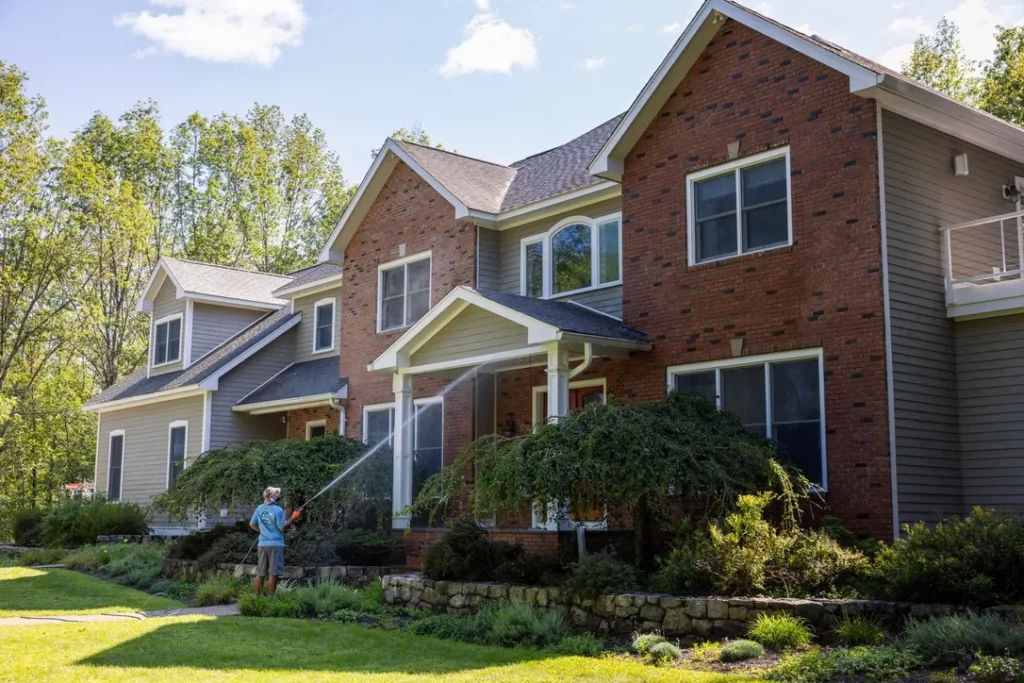
The straight answer for a Dutchess County home: every two to three years, and sooner for the shaded side of the house. Not annually, which is what companies that pressure wash will tell you, because a pressure rinse leaves the growth alive and you are calling them back next spring. Not every five years either, because by then the algae has been feeding on the siding long enough to cost you paint. Here is what actually grows on a Hudson Valley house, how fast, what moves the interval up or down, and the schedule that keeps the house clean for the least money.
What Is Growing On The House
Three things, and none of them is dirt. The green film on the north wall is algae, and it lives wherever a surface stays damp in the shade. The black speckling under the eaves and around the windows is mildew. The gray-brown streaks running down from the gutter corners are tannin and grime washing off the roof edge. All three arrive on the wind, take hold on the side of the house that dries slowest, and spread from there. On a wooded lot in Hopewell Junction or Fishkill with oaks and maples over the roofline, the north and east walls can go from clean to visibly green in eighteen months. A house on an open lot in full sun can hold three years and look fine. The painted farmhouses around Millbrook and the clapboard in Rhinebeck village sit at the two-year end of the range, because mildew works into the texture of paint faster than it does into vinyl.
Why Two To Three Years, And Not One
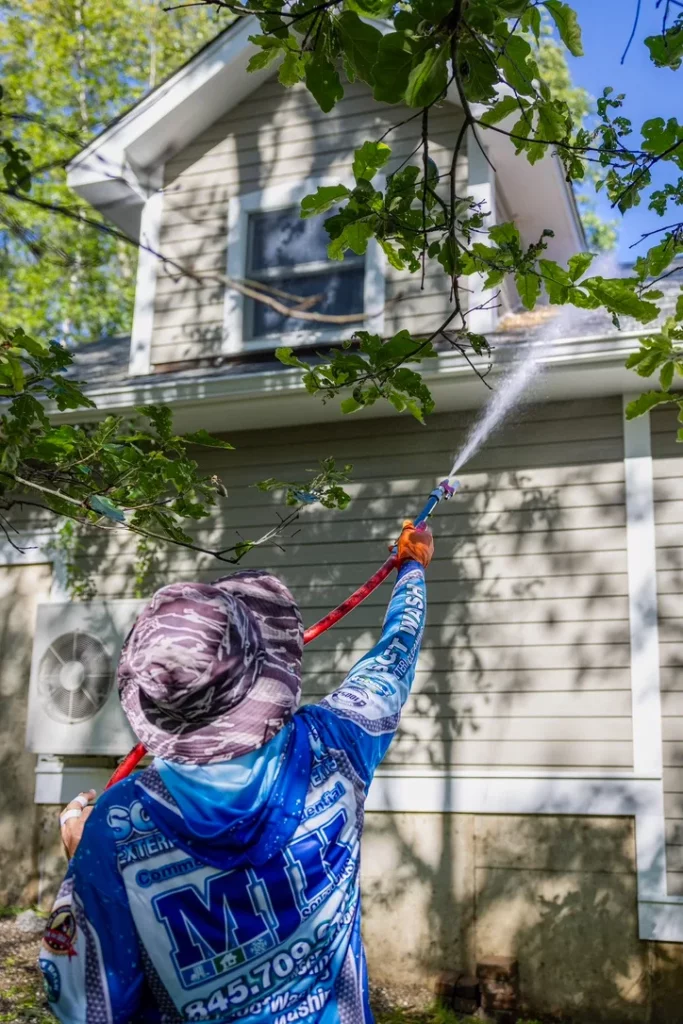
Because a soft wash kills the growth instead of knocking it off. The cleaning solution is applied at low pressure, the algae and mildew die at the root, and the walls stay clean for two to three seasons, longer on the sunny sides. A pressure wash strips the visible layer and leaves the organism behind, so the green is back within the year, and the high pressure that removed it has lifted paint, forced water behind the vinyl and left wand marks along the way. The annual schedule you see recommended online is the pressure-washing schedule. It exists because pressure washing does not last. Our page on soft washing versus pressure washing explains the difference for every surface on the house.
What Moves The Interval Up Or Down
Trees and shade. The single biggest factor. A wall that sits under a canopy stays damp until mid-morning and grows algae twice as fast as the same wall in the open. Oaks and maples over the roof also feed the gutters, and a gutter that overflows streaks the siding below it. Which way the house faces. North and east walls dry last and green first; south and west walls can go years. Most homes in Dutchess County end up needing the shaded side before the rest of the house, which is why we look at the house rather than the calendar. Water nearby. Homes near the river, a lake or a wet lot in Wappingers Falls or Beacon live in higher humidity and grow film faster than the ridge lots above them. Siding color. Light siding shows the green a year before dark siding does; the growth is the same, you just see it sooner. Traffic. A house on Route 9 or Route 52 collects road grime and pollen on the front face that a house on a cul-de-sac never does.
The Schedule By Siding
Vinyl: every two to three years. Vinyl does not rot, but the growth dulls the color and holds dirt, and once the finish oxidizes it never looks new again. Painted wood and fiber cement: every two years, and always before a repaint, because paint over mildew fails early. Regular washing is the cheapest way to push the repaint out by years. Brick and stone: every three to five years, unless the mortar is holding green, which means water is sitting in it through the freeze-thaw cycle. Stucco: every two to three years, because stucco holds moisture and the growth works into the texture. Aluminum: every two to three years, sooner once it starts chalking.
The Signs You Are Already Overdue
A green tint on the north side you can see from the street. Black dots under the soffits or along the bottom course of siding. A dark shadow under every window sill. Chalk on your hand after you touch the siding. Gutter-corner streaks that stay after a rain. A house that looks fine from the driveway and gray from the back yard. Any one of these means the growth has been feeding for a season already, and the wash should be booked now rather than at the next planned interval.

When In The Year To Do It
Late spring, once the pollen has finished, is the first good window: the house is clean for the season people are actually outside looking at it, and the growth that started over the wet spring is killed before summer humidity feeds it. Early fall, September into October, is the second: the house goes into winter clean, the mildew does not get a damp six months to spread, and it pairs with the fall gutter cleaning. The season runs from early spring into late fall; the one thing that stops a house wash is a freeze.
The Whole Exterior, Not Just The Siding
The siding is the part you notice, but it is on the same schedule as everything around it, and the same visit handles most of it. The roof runs on its own three-to-five-year cycle; the black streaks are algae feeding on the shingle, and a soft wash removes them under a one-year warranty. Gutters are twice a year, with the fall visit after the oaks drop. Windows pair naturally with the house wash, since the siding is clean and the screens come off anyway. The deck and fence go when they gray, and the walkways and patio every year or two before the algae makes them slick. Done together, each additional service comes in at a package rate, and the house looks like one job instead of five.

Done Right, Or Not At All
A house wash is only cheap if it does not cost you siding. Low pressure only, on every wall, with the landscaping protected. A licensed, fully insured crew, so a slip off a ladder is our problem and not your homeowner’s policy. A firm price in writing before we start, and a satisfaction guarantee behind the work. Picture two colonials on the same Hopewell Junction street: one pressure washed with a rented machine last spring, one soft washed three summers ago. From the road they look the same today. Only one of them has water behind the vinyl and a paint bill on the way.
What It Costs To Wait
A house wash starts at $495 in Dutchess County, and a typical colonial runs a few hundred more. A repaint on the same house runs into five figures, and mildew under the old coat is the most common reason a new one fails early. Vinyl that oxidizes from years of growth cannot be brought back. Caulk that stays wet behind algae lets water into the wall. The two-to-three-year wash is not a cosmetic expense; it is what keeps the expensive work on the house from arriving early.
Put It On A Schedule
The homes that look best year after year are the ones that stopped deciding. A maintenance plan puts the house wash on a two-to-three-year cycle with the roof, gutters and windows at a package rate, and the fall visit gets booked before the calendar fills. If you would rather start with one wash, send us your address and a photo from the driveway and you will have a firm number, usually the same day. Request a quote or call (845) 709-9443.
House Washing Frequency FAQ
Every two to three years for most homes in Dutchess County. A shaded or north-facing house under heavy tree cover needs it closer to every year or two. The interval depends on how much sun the walls get, not on the calendar.
Because they pressure wash. A pressure rinse strips the visible layer and leaves the algae and mildew alive, so the green is back within the year and the schedule has to be annual. A soft wash kills the growth at the root and holds two to three seasons. The annual advice is a description of the method, not the house.
Late spring after the pollen has finished, or early fall before the first freeze. Both leave the house clean for the season people actually look at it. The season runs from early spring into late fall; the only hard limit is freezing temperatures.
Not with a soft wash. The cleaning solution is rinsed at garden-hose pressure and is safe on vinyl, painted wood, fiber cement, brick and stucco. What damages siding is high pressure, not frequency.
House washing starts at $495 in Dutchess County. A typical ranch or cape runs a little more, a two-story colonial more again, and the number depends on the size, the stories and the condition of the siding. Every job is quoted at a firm price in writing before we start. Our house washing cost guide lists the starting prices by home type.
If they need it, yes. The roof is soft washed first, then the house, then the gutters are cleared, so everything is clean on the same day and each additional service comes in at a package rate. Most homes pair the house wash with a window cleaning; the roof runs on its own three-to-five-year cycle.


